By Gerriann Jackson, MS, CCC-SLP | VoiceOver Speech Pathology
When one side of your face suddenly stops moving, the internet will tell you to exercise harder. That advice is wrong for a flaccid face without usable nerve input. Bell’s palsy therapy is stage-specific. Early care protects the eye and mouth, teaches the patient what is happening and keeps the affected side present in the brain’s sensory-motor map. When nerve activity returns, treatment shifts toward soft-tissue mobilization and precise facial retraining to improve movement and reduce unwanted linked movements.
The short answer to the question can “Bell’s Palsy therapy, facial retraining help recovery? “is yes: facial retraining helps recovery when it matches the stage of nerve recovery, and associated symptoms, muscle tone and movement pattern. The right technique at the wrong stage is the wrong treatment and can be useless at best and harmful at worst.
Bell’s Palsy Therapy Starts With Immediate Medical Care
New facial weakness requires immediate medical evaluation. Bell’s palsy is a diagnosis made after stroke and other causes of facial paralysis have been considered. The American Academy of Otolaryngology–Head and Neck Surgery clinical guideline calls for oral steroids within 72 hours of symptom onset for appropriate patients and eye protection whenever eyelid closure is impaired. Rehabilitation does not replace emergency diagnosis, medication or ophthalmic care.
If the eye does not close, the cornea can dry and become injured. If speech sounds different because the lips and cheek are weak, food and liquid can leak from the mouth and food can remain trapped in the cheek. These problems deserve active management from the beginning.
Next step: If facial weakness is new, sudden or worsening, seek emergency medical evaluation now. Begin rehabilitation after urgent causes have been addressed.
Why Should I Start Bell’s Palsy Therapy During the Flaccid Stage?
We prefer to see patients immediately, during the flaccid stage. This first phase is not about forcing a smile. It is about education, protection and preparation. We explain the anatomy and physiology of the facial nerve and muscles so the patient understands what has stopped working and why. We also identify problems that need coordinated care from ophthalmology, dentistry, otolaryngology or another medical specialist.
Bell’s Palsy Therapy Encompasses Education
Early treatment that you may not get from the Emergency Room staff includes anatomy and physiology of the facial nerve and what to expect as you recover. Education about eye-care, oral-care along with help locating useful tools during your recovery is valuable component of management of the early stages that most people do not get from their physicians. We teach patients how to protect an eye that does not blink or close, how to manage lip and cheek weakness, and how to clear food that collects between the cheek and teeth. We recommend Facial Palsy UK’s initial guidance as one of the most useful patient resources because it addresses the practical problems people face during the first weeks.
Bell’s Palsy Therapy Maintains the Brain’s Map of the Face
The face is controlled by a sensory-motor network. Facial nerve injury causes absence of sensory information to the motor cortex of the brain and cause the brain to lose representation of the affected side of the face, which can make recovery, even with return of neural function of the muscles, difficult. We teach patients how to maintain this cortical representation so the brain continues to recognize it as the damaged nerve comes back online. This is guided sensory-motor work, not repetitive strengthening.
Next step: Request an early facial rehabilitation evaluation after the medical diagnosis is established. Do not wait for tightness or synkinesis to become entrenched.
Specialized Training Matters in Bell’s Palsy Therapy
Choosing a therapist, whether SLP, OT or PT is important. Choose someone who as completed advanced training through Facial Therapy Specialists International, an international organization dedicated to quality care for people with facial palsy. Its education is built for speech-language pathologists, physiotherapists and occupational therapists and requires a deep understanding of facial nerve anatomy, physiology, assessment, prognosis and stage-specific rehabilitation. The training is evidence-based, clinically rigorous and led by internationally recognized facial rehabilitation specialists. That training is the basis of VoiceOver’s facial neuromuscular rehabilitation for facial palsy. Care begins with an individualized assessment of resting symmetry, voluntary movement, soft-tissue restriction, hypertonicity, functional problems and synkinetic patterns. The plan follows the face in front of us, not a generic calendar or online exercise sheet.
Next step: Read about VoiceOver’s facial rehabilitation program and compare that individualized approach with any program you are considering.
Facial Retraining Changes as Bell’s Palsy Recovery Changes
A thorough evaluation determines what each person needs. Facial paralysis is not one uniform condition. One patient has complete flaccidity. Another has partial return with weak selective movement. Another has had some neural recovery but movement trapped by hypertonicity and unwanted co-contraction. Each pattern requires different treatment.
Soft-Tissue Mobilization To Treat Hypertonicity
As tone increases, tight tissue can restrict movement and create pain, pressure and fatigue. Early follow-up lets us treat hypertonicity as soon as it appears. Soft-tissue mobilization reduces restriction, improves comfort and gives the intended movement more room to occur. Patients who reduce hypertonic muscle tone are more comfortable overall, even before they notice a return of movement.
Delinking Retrains Unwanted Movement
Synkinesis occurs when an intended movement activates another muscle group at the same time. For example the eye closes during smiling or chewing. The mouth pulls when the patient blinks. The neck tightens during speech. These aberrant movements occur when a nerve regrows into a tubule that guides it to innervate the wrong muscle.
At VoiceOver the delinking process begins approximately two months after soft-tissue mobilization starts, when the patient can detect the aberrant activation and control the target movement. The patient learns to feel the unwanted muscle engage, reduce its activity and produce the intended movement without recruiting it. Delinking depends on attention, precise feedback and repeated correct movement—not force.
Next step: Schedule an assessment if your face feels tight, your eye narrows when you smile or your mouth moves when you blink.
Bell’s Palsy Therapy Is Not a Generic Facial Exercise Program
Trying to push a muscle that has no usable innervation is useless at best. At worst, forceful practice increases broad mass movement and the risk of reinforcing synkinetic patterns as nerve activity returns. No amount of effort can make a disconnected nerve deliver a voluntary signal.
During flaccid paralysis, we do not prescribe repeated smiling, forceful eye squeezing, cheek puffing or resistance work. Facial Palsy UK’s flaccid-stage guidance gives the same central message: do not push the face to move faster. Gentle massage, protection, education and relaxation are different from active facial exercise.
Why I Do Not Use E-Stim as a Shortcut
Electrical stimulation remains contested. A 2026 systematic review and meta-analysis found fewer incomplete recoveries when electrical stimulation was added during acute Bell’s palsy, but the included studies had short follow-up and risk-of-bias limitations. That evidence does not establish long-term coordination, selective movement or protection from synkinesis. Contraction is not coordination. I do not use e-stim as a substitute for nerve-status assessment and voluntary neuromuscular retraining.
Next step: Before beginning facial exercises, resistance work or electrical stimulation, have your nerve status and movement pattern evaluated by a clinician trained in facial rehabilitation.
What Current Research Says About Bell’s Palsy Therapy
The evidence now supports stage-specific facial rehabilitation. A 2022 systematic review of facial exercise therapy found stronger evidence for benefit early in recovery and additional evidence supporting treatment in chronic cases. The review also identified a persistent problem: studies use different protocols and outcome measures, which makes one-size-fits-all programs scientifically indefensible.
A 2023 study of early neuromuscular retraining found better final facial function when treatment began before synkinesis developed. An international systematic review and clinical practice recommendation defines synkinesis as a movement-coordination disorder and places facial training with feedback first, followed by botulinum toxin when appropriate. Surgery is reserved for selected cases after conservative treatment.
The research and my clinical experience point in the same direction: educate early, protect function, avoid force, monitor for rising tone, and introduce selective movement training when the nervous system is ready.
Next step: Choose a provider who can explain why each technique is being used, what stage it matches and how progress will be measured.
Case Study: Bell’s Palsy Therapy for a Young Attorney
A young attorney came to us after Bell’s palsy left her with hypertonicity on the affected side, reduced superior and inferior smile excursion, and eye closure during smiling and chewing. She was focused, observant and able to devote sustained attention to the retraining process. We began with soft-tissue mobilization. Releasing restriction allowed greater excursion of the zygomatic muscles—the primary elevators involved in the superior portion of the smile. She developed a nearly symmetrical superior smile. We then moved to neurological re-education to delink the eye muscles from smiling and chewing. She first learned to feel the aberrant eye-muscle activation as it began. With focused practice, she stopped recruiting the eye during those oral movements. She ultimately delinked the movements altogether. We recommended that she continue spending time each week monitoring smiling and chewing so she could respond immediately if the eye began trying to rejoin the pattern. She did not regain neurological input to the depressor muscles responsible for inferior smile excursion. We recommended botulinum toxin to the unaffected side to reduce the imbalance and create a more symmetrical inferior smile. She was very happy with her outcome.
Next step: Request a personalized facial rehabilitation evaluation if unwanted eye closure, facial tightness or an uneven smile is affecting your work, eating or communication.
Bell’s Palsy Therapy Can Help Long-Standing Facial Paralysis
Early care is better, but a delayed start does not eliminate the value of treatment. We evaluate long-standing facial paralysis after Bell’s palsy, Ramsay Hunt syndrome and surgery for brain tumors or other facial-nerve conditions. Chronic hypertonicity remains amenable to soft-tissue mobilization. Established synkinesis remains amenable to delinking and selective movement retraining.
VoiceOver offers in-person and virtual appointments. Most patients can begin without a physician referral; Medicare patients need a referral. Once care is established, we may request the relevant physician notes so the rehabilitation plan reflects the diagnosis, surgical history, nerve status and medical recommendations.
Next step: Do not assume you have missed the treatment window. Request an evaluation and let the examination determine what can still change.
Who Should Seek Bell’s Palsy Therapy and Facial Retraining?
Contact VoiceOver immediately after a medical diagnosis of facial paralysis or when any of these problems persist:
Diagnosis of Bell’s palsy or Ramsay Hunt syndrome
Facial paralysis after brain-tumor or facial-nerve surgery
An eye that will not close or blink normally
Food collecting in the weak cheek or liquid leaking from the lips
Reduced smile excursion or facial asymmetry
Facial tightness, pain, pressure or fatigue
Synkinesis
Eye closure during smiling, chewing or speaking
Mouth movement during blinking or eye closure
Neck tightening during speech or facial expression
Long-standing synkinesis that has never received specialist retraining
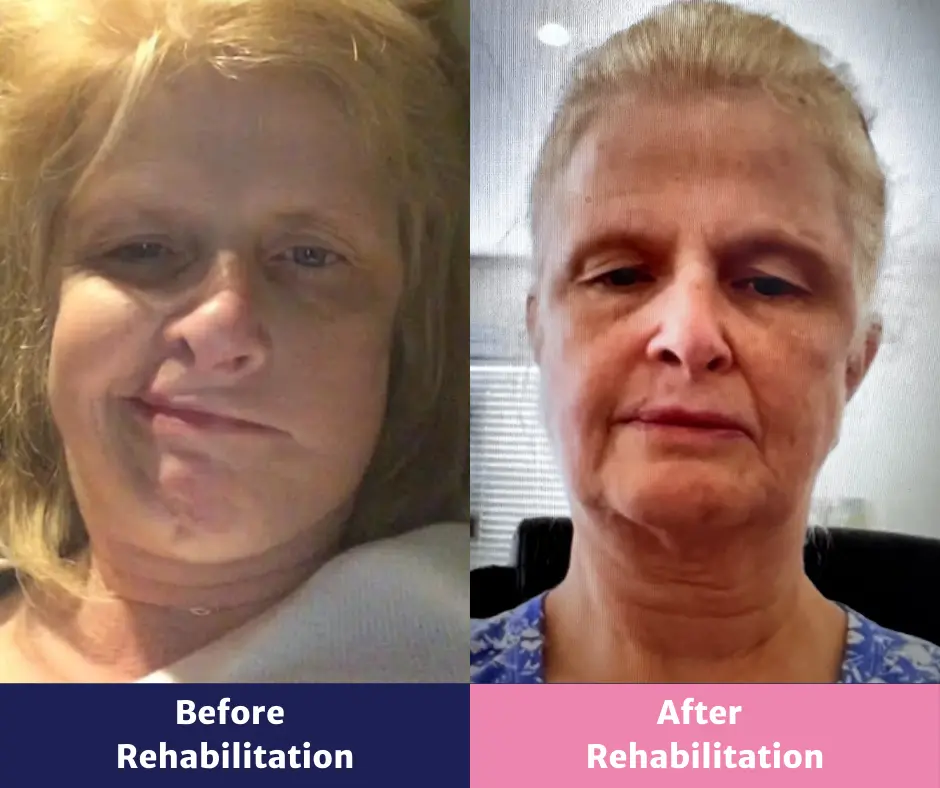
*not case study individual
Next step: Request an appointment with VoiceOver Speech Pathology or call 585-623-6400. The earlier you understand what is happening, the sooner appropriate care can begin.
Facial expression is an integral part of communication, identity and professional presence. Rehabilitation is not cosmetic indulgence. It is helping people regain the ability to engage in human connections
Evidence and Patient Resources for Bell’s Palsy Therapy
Facial Therapy Specialists International: Professional education, clinical evidence and international facial-rehabilitation standards.
Facial Palsy UK: Initial Advice and Guidance: Practical early-stage guidance for eye care, oral care, emotions and daily function.
Facial Palsy UK: Management of Flaccid Facial Paralysis: Specialist guidance on massage, eye protection and what to avoid before movement returns.
Facial Palsy UK: Synkinesis Advice: Clear explanations of eye-mouth linking, hypertonicity and specialist treatment.
Khan et al., 2022: Systematic Review of Facial Exercise Therapy: Evidence supporting facial therapy in early recovery and chronic cases.
Kim et al., 2023: Early Neuromuscular Retraining: Research on timing and minimizing synkinesis after severe Bell’s palsy.
Guntinas-Lichius et al., 2022: Synkinesis Practice Recommendations: International assessment and treatment recommendations for facial synkinesis.
AAO-HNS Clinical Practice Guideline: Bell’s Palsy: Medical diagnosis, early steroid treatment, eye protection and follow-up guidance.
Next step:
Contact VoiceOver and save these resources, share them with your medical team and use them to avoid forceful, generic treatment during the wrong stage of recovery.